Tree Removal · University City, MO
Tree Removal in University City, MO
University City homeowners call about towering shade trees on older blocks near Delmar, storm damage on the north side and stumps left after a removal. We connect you with an independent tree service that works in U City.
We operate this website and pass your request to an independent tree service that covers University City. The contractor calls you back, asks about the tree, access and cleanup, and gives you a price. You decide whether to hire them, and asking costs nothing.
Call (314) 816-2884St Louis City Tree Removal operates this website and connects local customers with independent local tree services. We don't do the work ourselves and we don't check any tree service's qualifications, so confirming that is up to you before you hire.
Request sent
A local contractor will reach out shortly. Watch for a call from an unknown number.
U City calls
What Tree Calls Look Like in University City
University City is the largest community on this part of our service area, with 35,065 residents in the 2020 census and about 5.9 square miles of land. That size brings variety. The older south end near Delmar Boulevard has big trees on narrow lots next to brick homes and apartment buildings, while the north side, which filled in mostly after World War II, has mid-century yards with trees that have reached full size.
Many calls come from owners of older homes who want a large tree removed or reduced before it damages a roof or a porch. Others want deadwood cleared from a tree they plan to keep. For that kind of work, our tree trimming and pruning page explains the difference between thinning, raising and reducing a crown.
Storm calls come from every part of the city. After a strong wind, the questions are usually the same: is the tree still safe, who owns the limb in the street, and how fast can someone get here.
Local history
From a Magazine Publisher's Model City to U City
In 1902, publisher Edward Gardner Lewis bought 85 acres northwest of Forest Park, near the grounds of the coming 1904 World's Fair. He planned a headquarters for his magazines, which included Woman's Magazine, and a model city in the spirit of the City Beautiful movement. Construction began in 1903 on the Magazine Building, an octagonal tower about 135 feet tall that now serves as City Hall.
The city was formally incorporated in September 1906, and Lewis became its first mayor. It was named for nearby Washington University, which had moved to its new campus northwest of Forest Park in 1905. Lewis also built an Art Academy and the Lion Gates, both designed by the firm Eames and Young, with the lions sculpted by George Julian Zolnay. The lions still mark the west end of the Delmar Loop.
Between 1910 and 1920, University City grew faster than any other city in Missouri. Delmar Boulevard became a commercial street served by streetcars in the 1920s, and the name of the Loop comes from a streetcar turnaround that once stood there. The biggest wave of house building came after World War II, and the population peaked at 51,249 in 1960.
That history explains the tree work. The southern, older part of the city keeps much of its early architecture, including districts such as University Heights Subdivision Number One and the Parkview Historic District. Trees planted along those streets decades ago can be very large, and they often stand close to historic buildings.
University City on the Map
University City stretches from Skinker Boulevard on the east toward Interstate 170 on the west, just north of Clayton and Washington University. Zoom in to find your neighborhood.
Local conditions
What Shapes Tree Work in University City
A handful of local conditions explain why U City tree jobs vary so much from one street to the next.
Two housing eras
The south end grew in the early 1900s, while much of the north side was built after World War II. Expect very large, very old trees near Delmar and mid-century yard trees farther north.
Historic districts
University City has 16 listings on the National Register of Historic Places, including several historic districts. Big trees close to historic masonry call for careful rigging so nothing strikes the building.
Two watersheds
Midland Boulevard runs along the divide between the Mississippi and Missouri river watersheds. The River des Peres rises near the Clayton border and flows north, then turns at Ruth Park before entering underground culverts.
Busy streets
Delmar, Olive and the streets near the Loop carry heavy traffic and transit. Work near those roads may need lane closures or traffic control, which the contractor should plan before the day of the job.
The contractor who visits can tell you which of these affect your job and how they change the price.
Who handles what
Who Do You Call About a Tree Near the Street in U City?
University City is a home rule charter city with a council and city manager, and it runs its own public works operation. If a tree stands between the sidewalk and the curb, or you are not sure whether it is on your lot, call city hall before anyone cuts it. The city can tell you whether the tree is a public tree and whether any permit or notice is required.
Some major roads through the city, such as Olive Boulevard, are state routes. Olive carries Missouri Route 340, and the Missouri Department of Transportation has jurisdiction along it. Work that blocks a state road may need MoDOT approval, so ask your contractor how they will handle it.
If you live in a historic district, ask the city whether tree work near a contributing building raises any review questions. Confirming permits and approvals is the property owner's responsibility, and asking first is far cheaper than fixing a problem later.
Before you call, note the street address and where the tree stands in relation to the sidewalk and curb. Photos help city staff and contractors answer faster. If the tree is shared with a neighbor, talk to them first, since both owners may need to agree on removal or pruning.
Job explained
Removing a Large Tree Next to an Older Brick Home
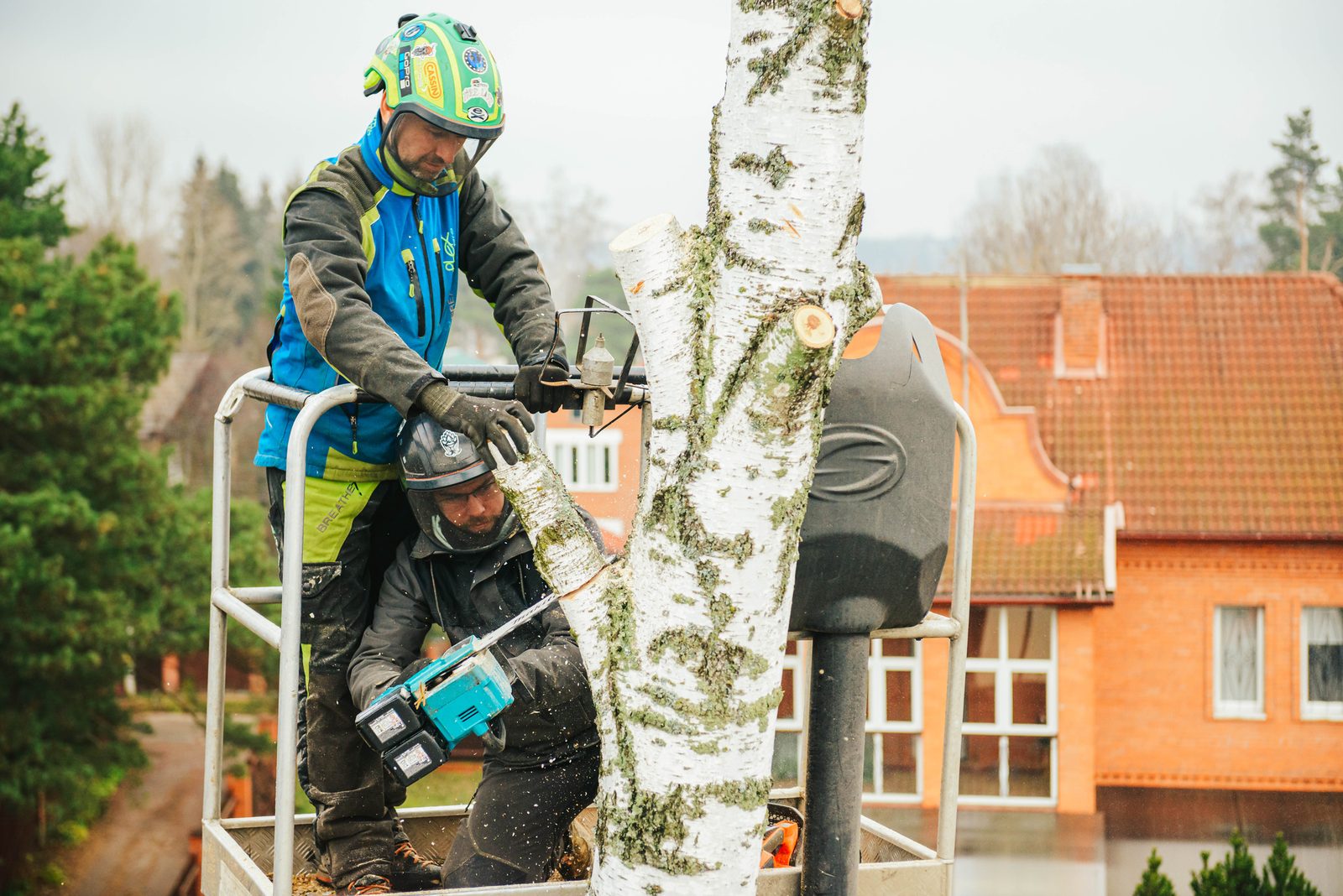
On the older blocks south of Delmar, a tree can be wider than the side yard it grows in. Removal usually means a climber or bucket truck working from the top down, cutting limbs into manageable pieces and lowering them with ropes. If a crane can set up in the street, the crew may lift larger sections over the house instead, which can be faster but requires street space.
Brick chimneys, slate roofs and old gutters do not take impacts well. Ask the contractor how they will protect them and what happens if something is damaged. A detailed written quote should say whether the price includes hauling, cleanup and the stump.
If you are not sure the tree needs to come down, ask for an opinion on its health first. Our tree health and arborist care page covers what a health check looks at, and our tree removal page lists questions to ask when it does have to go.
Watch
See Tree Removal in Action
This short video shows how a crew takes down a big tree in sections when buildings stand close by.
Before you hire
Questions to Ask Before You Hire
University City sees plenty of door knocking after storms. Before you sign with anyone, get a written estimate that lists the business name, a working phone number and exactly what is included. Avoid paying the full price before the work is done.
We do not check, verify or confirm contractors' licenses, insurance or credentials. Confirming those things is your responsibility before you hire. Ask for a certificate of insurance mailed or emailed to you by the insurer, and ask whether anyone on the crew holds the ISA Certified Arborist credential, which you can check with the International Society of Arboriculture.
If you live in a condo or an apartment building, the association or landlord usually controls tree work on shared ground. Talk to them first.
Compare at least two written quotes when the job is large. Look at what each includes, such as rigging, crane time, hauling, stump grinding and cleanup, rather than the bottom line alone. A much lower price often means something was left out.
Around the city
The Loop, the Parks and the Roads
The Delmar Loop is the city's best known street. The American Planning Association named it one of the 10 Great Streets in America in 2007. The Loop runs from the University City Lions near City Hall east toward the City of St. Louis line, and a heritage trolley connects it with Forest Park.
University City has 17 parks and a nine-hole public course at Ruth Park, which also has nature trails. Heman Park is the largest at about 85 acres, with a community center and a public pool. The University City Public Library on Delmar opened in 1939.
Major roads include Interstate 170, Delmar Boulevard, Olive Boulevard, Forest Park Parkway and Skinker. Two MetroLink Blue Line stations, University City Big Bend and Skinker, sit on the southern edge. Students attend the School District of University City, including University City High School.
Keep exploring
Services and Nearby Areas
Stump Grinding
Stumps left from city ash removals and old backyard maples are common here, and we connect owners with independent tree services that grind below grade after 811 marks the lines and limestone is accounted for.
Emergency & Storm Tree Removal
When storms like the May 2025 tornado drop limbs on roofs and across alleys, we connect city owners with independent tree services that remove fallen trees once Ameren has made any downed lines safe.
Lot & Land Clearing
Vacant city lots and rehab properties often hide years of volunteer trees and brush, and we connect buyers and owners with independent crews that clear growth while keeping the healthy shade trees you want.
Hanley Hills
Hanley Hills is a village of about 2,000 people on 0.36 square miles, and its city hall offers request forms for removing dead trees from residents' yards through a grant-funded program.
Shrewsbury
Shrewsbury grew around a Frisco Railroad station dedicated in 1890 and incorporated in 1913, and its garden club has cared for the city's trees and flowers since 1947.
Brentwood
Brentwood began as Maddenville, named for 1870s quarry owner Thomas Madden, and became a village in 1919 to avoid annexation by Maplewood before growing to 12,250 people by 1960.
University City Tree Removal Questions
Do I need permission to remove a tree in University City?
For a tree fully on your lot, usually not, but call city hall to confirm before work starts. For a tree near the curb or sidewalk, ask whether it is a public tree, because the city may handle it.
Does living in a historic district affect tree work?
University City has several historic districts on the National Register. Ask the city whether your project needs any review, especially if work could affect a historic building.
Why do U City tree removals cost more on older blocks?
Older blocks often have very large trees on narrow lots close to brick homes. That means more rigging, more time and sometimes a crane, which raises the price the contractor sets.
Who handles trees along Olive Boulevard?
Olive carries Missouri Route 340, and MoDOT has jurisdiction along it. Ask city hall or MoDOT before work that affects the road or right-of-way.
Should I trim or remove an old tree?
It depends on the tree's health and structure. Ask a contractor to look at it in person, and consider a health check before deciding on removal.
How do I get a quote in University City?
Call (314) 816-2884 or use the form. We pass your request to an independent tree service that covers University City, and they call you back with questions and a price.
Talk to a Tree Service Serving University City
Call (314) 816-2884 and we'll pass your request to an independent local tree service who can call you back with a price.
Call (314) 816-2884We operate this website and connect local customers with local tree services. St Louis City Tree Removal doesn't perform tree work, doesn't supervise tree services, and doesn't check any tree service's insurance, licensing, or credentials, so confirm those yourself before hiring.
Disclaimer
How This Website Works
Disclaimer: St Louis City Tree Removal operates this website to connect local customers and businesses in University City, MO and nearby communities with independent local tree services. We are not a tree service, we do not perform, supervise, or warrant any tree work ourselves, and we do not check, verify, or confirm any tree service's license, insurance, bonding, credentials, or qualifications. Confirming those things is the customer's responsibility before hiring. Any price you're quoted comes from the tree service, not from us, and any agreement and the work itself are strictly between you and the tree service you choose. Calls placed through this site may be routed to an available local tree service. See the full disclaimer. Same-day and 24/7 emergency services are subject to provider participation, location, technician availability, and demand. Availability is not guaranteed and may vary by market and appointment capacity.